

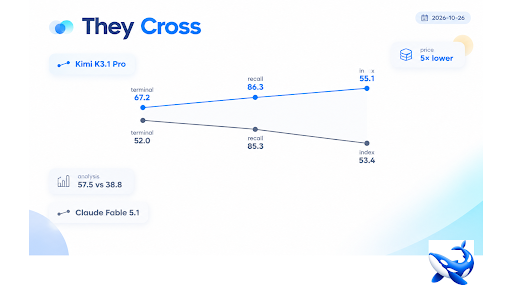
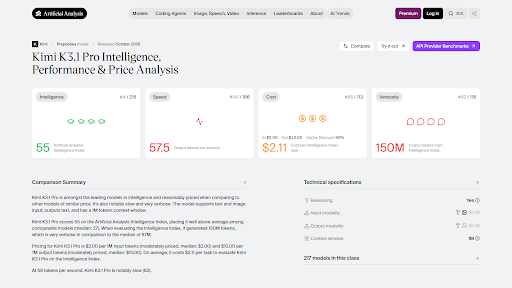
Kimi K3.1 Pro and Claude Fable 5.1 are 1.74 index points apart: 55.09 against 53.35 [INDEPENDENT, index v4.3.2, 26 October]. On individual rows they are as far as 18.75 points apart, and they swap sides depending on which row you read. Kimi wins terminal work by 15.2 points; Fable wins agentic analysis by 18.75 and knowledge by 13.9. The OrcaRouter card for Kimi 3.1 Pro shows its side of the split next to the $2.00/$10.00 rate card, which is a fifth of Fable’s blended price and the reason this pair is worth a careful read rather than a quick one.
A composite that says “these two are the same” is describing two models that are not the same. This comparison is the clearest illustration in the field of why an index is a summary rather than an answer.
Side by side
| Kimi K3.1 Pro | Claude Fable 5.1 | Gap | |
| AA Intelligence Index | 55.09 | 53.35 | Kimi +1.74 |
| Input / output per 1M | $2.00 / $10.00 | $10.00 / $50.00 | Kimi, 5× cheaper |
| Blended 3:1 | $4.00 | $20.00 | Kimi, 5× cheaper |
| Terminal-Bench 4.0 | 67.17% | 52.02% | Kimi +15.15 |
| Long-context recall | 86.33% | 85.33% | Kimi +1.00 |
| SciCode | 60.76% | 63.08% | Fable +2.32 |
| Humanity’s Last Exam | 52.46% | 59.13% | Fable +6.67 |
| Omniscience | 29.52 | 43.45 | Fable +13.93 |
| Knowledge accuracy | 51.02% | 67.23% | Fable +16.21 |
| CritPt | 24.57% | 29.71% | Fable +5.14 |
| AnalystAgent | 38.75 | 57.50 | Fable +18.75 |
| Output speed | 57.5 tok/s | 69.9 tok/s | Fable |
Two things stand out immediately. Fable has the highest knowledge accuracy in the entire comparison set at 67.23% — higher than Claude Opus 5.5’s 66.21% — while scoring below it on the omniscience index. And Kimi’s terminal lead over Fable is the second-largest component win in the field after the Opus comparison.
Why the two profiles look like this
Fable 5.1’s profile is unusually coherent: it is strong on every row that rewards holding a lot of context in the weights and using it well under open-ended direction — knowledge, research-grade physics, agentic analysis — and weak on the one row that rewards operating a machine under a scaffold. That is what a model optimised for judgement-heavy professional work looks like, and the 5× price is what that positioning costs.
Kimi’s profile is the mirror: strongest on terminal operation, long-context recall and code, weakest on knowledge, analysis and research-grade reasoning. It is a model built to execute over material you supply, and it is priced accordingly.
Neither profile is better. They are different products that score the same on an average of ten evaluations.
The decision, by workload
Terminal agents, coding agents, CI automation, anything that runs commands: Kimi, without much deliberation. Fifteen points on Terminal-Bench is the largest gap in this article, and it comes with a fifth of the price.
Analysis with an open goal — “figure out why”, “build the case for”, “decide what to investigate”: Fable. Eighteen and three-quarter points on AnalystAgent is the largest gap in either direction, and no price advantage compensates for a model that wanders.
Knowledge work with short prompts: Fable, on a 16.2-point accuracy lead. This is the row where Kimi’s 43.89% hallucination rate is the operative number.
Long-context retrieval over documents: effectively a tie — 86.33 against 85.33 — and therefore a price decision, which Kimi wins five to one.
Mixed traffic: route. The rows that separate these two are visible in the request itself: a request that carries a tool loop is Kimi’s; a request that asks for judgement is Fable’s. On one key, the policy is a classifier and two model strings.
What the price gap buys and does not
A 5× blended price difference is the largest in the field short of cheap-tier models. It buys, in Kimi’s case: 15 points of terminal work, 1 point of recall, and 1.74 of composite.
It does not buy: knowledge, analysis, research reasoning, or speed. And the price gap is not a temporary launch discount — Fable is on a $10/$50 card by design, at the top of the market, and Kimi is on a $2/$10 card by design.
The useful way to hold both facts: on the two rows where Kimi leads, the price gap makes it an automatic choice; on the four rows where Fable leads, the price gap is the only reason to hesitate, and the hesitation is correct. A team whose work is analyst-shaped should pay the 5× and stop reading comparisons. A team whose work is agent-shaped should stop paying it.
What five times buys in a real budget
Take a workload a mid-size team might actually run: 600,000 requests a month, each reading 4,000 tokens and writing 1,500. That is 2.4 billion input tokens and 900 million output tokens. On Kimi K3.1 Pro at $2.00 and $10.00 the bill is $4,800 plus $9,000 — about $13,800. On Claude Fable 5.1 at $10.00 and $50.00 it is $24,000 plus $45,000 — about $69,000. The difference is $55,000 a year, which is a headcount.
Now ask what that money buys. On this workload — short prompts, mid-length answers, no tool loops — the analyst and knowledge rows are the ones that decide quality, and Fable leads both, by 13.9 and 18.75 points. A team whose output a client reads may decide the $55,000 is cheap. A team whose output is a structured extraction that either passes a check or does not will see none of that quality, and the 5× is pure overhead.
That is the honest form of the comparison: not “Kimi is five times cheaper”, which is true and uninformative, but “the five times buys four rows you may not use”.
Caching does not close the gap either, which is worth checking because it is the optimisation most teams apply first. At 90% cache hits Kimi’s effective input falls to $0.38 per million and Fable’s to $1.22, so the ratio survives almost unchanged — a little over three to one on the input line, and five to one on output. The only lever that meaningfully changes the arithmetic is shorter answers, where a fixed per-request cost matters more than a per-token rate. Note also the relative shape: Fable’s cache read is 2.5% of its own input price, Kimi’s is 10%, so on a cache-heavy workload the five-times absolute gap is the number that lands on the bill.
The one-line summary
Kimi K3.1 Pro and Claude Fable 5.1 are within 1.74 points of each other overall, 15 points apart on terminal work in one direction and 19 points apart on agentic analysis in the other. Buy the one whose rows describe your traffic; the composite will not decide it for you.
Sourcing note: every score, rate card, cache price, blended price and speed is Artificial Analysis on index v4.3.2, read 26 October 2026, with both models at maximum effort. Fable’s knowledge accuracy of 67.23% is the evaluator’s Omniscience accuracy row. Our route serves Kimi K3.1 Pro at the vendor’s list price; Fable’s card is Anthropic’s published list. The workload decision rules and the routing suggestion are ours.