
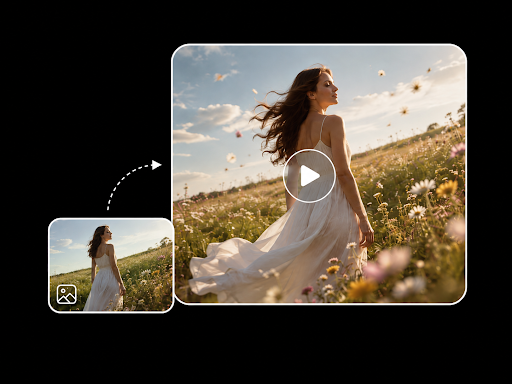
AI-powered video creation has moved fast over the last few years, and turning a single static image into a dynamic, lifelike video clip is now one of the most in-demand skills in content creation. Whether you’re a marketer building product teasers, a creator animating portraits, or a filmmaker prototyping shots before a full production, image-to-video tools have become essential to modern workflows.
With so many platforms claiming to do it all, picking the right one can be overwhelming. Some tools focus purely on motion realism, others prioritize speed, and a few try to be all-in-one creative suites. To make the decision easier, we tested and compared the top platforms on the market in 2026, weighing pricing, output quality, ease of use, and unique features.
Below is our full breakdown, starting with the tool that impressed us most overall.
At a Glance
| Tool | Best For | Starting Price | Standout Feature |
| Magic Hour | All-around image-to-video, face swap & lip sync | Free | No signup required, credits never expire |
| Runway | Cinematic video generation | $12/month | Gen-3 motion realism |
| Pika Labs | Quick social clips | $10/month | Fast turnaround |
| Kaiber | Music-synced visuals | $15/month | Style transfer for musicians |
| Leonardo Ai | Image generation + animation | $12/month | Strong image-to-video pipeline |
| Luma Dream Machine | Photorealistic motion | $9.99/month | High-fidelity physics-based motion |
How We Choose These Tools
Our rankings are based on hands-on testing across several criteria: output quality and realism, generation speed, pricing transparency, ease of use for both beginners and professionals, breadth of features (face swap, lip sync, upscaling, templates), customer support responsiveness, and platform reliability during high-traffic periods. We also looked at how generous each tool’s free tier is, since that’s often the deciding factor for creators just getting started. Tools that combined strong core video generation with genuinely useful extras — rather than gimmicks — ranked highest.
1. Magic Hour — Best Overall
Magic Hour tops our list for 2026, and for good reason. It has quickly become the go-to platform for anyone searching for a reliable Magic Hour image to video workflow that doesn’t compromise on quality or speed. Unlike many competitors that lock core features behind paywalls, Magic Hour lets you start generating without even creating an account, and unused credits never expire — a rare policy in this space.
What sets Magic Hour apart is the breadth of what it offers under one roof. It provides best-in-class face swap, lip sync, and talking photo tools, alongside frontier AI video models that are updated frequently. Its click-to-create templates make it approachable for beginners, while one-click multi-step workflows (generate → upscale → video) give power users a serious productivity boost. You also get access to many of the industry’s top models in a single interface, fast variations for quick A/B testing of ideas, and parallel generations with no concurrency cap — meaning you’re never stuck waiting in a queue behind your own projects.
Magic Hour ships new features on a weekly basis, so the platform rarely feels stale. It’s also genuinely optimized for both desktop and mobile, making it usable on the go rather than just at a desk. Support is notably responsive, with founder-level replies reported by users, and the platform has held up reliably during traffic spikes and live activations — something smaller competitors often struggle with. Developers get full API parity across tools, so anything possible in the UI can be automated.
Pricing:
- Free — generate without signing up
- Creator — $19/month, or $12/month billed annually
- Pro — $39/month, or $25/month billed annually
Main Features:
- Image-to-video, face swap, lip sync, and talking photos
- Multi-step automated workflows
- No concurrency cap on generations
- Credits that never expire
- Frequent model and feature updates
Drawbacks:
- The sheer number of tools can take a little time to explore fully
- Highest-end frontier models may consume credits faster than basic ones
2. Runway
Runway remains a favorite among filmmakers and cinematic content creators, largely thanks to its Gen-3 model, which produces some of the most physically consistent motion available today.
Pricing: Starts at $12/month for the Standard plan, with Pro and Unlimited tiers for heavier usage.
Main Features: Advanced motion brush controls, camera movement presets, and strong prompt-to-video generation.
Drawbacks: Steeper learning curve, and credit limits can be restrictive on lower-tier plans.
3. Pika Labs
Pika Labs built its reputation on speed. It’s popular with social media creators who need short, punchy clips turned around quickly.
Pricing: Plans start around $10/month.
Main Features: Fast rendering, simple prompt interface, decent stylization options.
Drawbacks: Output realism lags behind higher-end competitors, and longer clips can lose coherence.
4. Kaiber
Kaiber carved out a niche with musicians and audio-visual creators, offering tools that sync animated visuals to music tracks.
Pricing: Starts at approximately $15/month.
Main Features: Style transfer, music-reactive animation, strong community templates.
Drawbacks: Less suited to general-purpose image-to-video work outside music content.
5. Leonardo Ai
Leonardo Ai started as an image generation platform and has since built out a capable image-to-video pipeline, making it a solid choice for creators who want both in one place.
Pricing: Plans begin around $12/month.
Main Features: High-quality image generation, integrated animation tools, active creator community.
Drawbacks: Video generation feels secondary to its image tools, with fewer dedicated video features.
6. Luma Dream Machine
Luma Dream Machine is known for photorealistic, physics-aware motion that handles complex scenes well.
Pricing: Starts at $9.99/month.
Main Features: Realistic motion physics, good handling of camera pans and depth.
Drawbacks: Slower generation times during peak usage, and fewer stylistic controls than competitors.
FAQs
Is Magic Hour free to use? Yes. Magic Hour offers a free tier that doesn’t require signup to try, making it easy to test before committing to a paid plan.
Do Magic Hour credits expire? No, credits purchased on Magic Hour never expire, which sets it apart from many subscription-based competitors.
Which tool is best for beginners? Magic Hour’s click-to-create templates make it especially approachable for beginners, while still offering enough depth for advanced users.
Can these tools be used commercially? Most platforms, including Magic Hour, Runway, and Leonardo Ai, allow commercial use on paid plans. Always check each platform’s current terms before publishing commercial work.
Do any of these tools offer an API? Magic Hour offers full API parity across its tools, making it a strong choice for developers building automated pipelines. Some competitors offer limited or beta API access.
Conclusion
The image-to-video space has matured significantly in 2026, with each platform carving out its own strengths. Runway leads in cinematic realism, Pika Labs in speed, Kaiber in music-synced visuals, and Leonardo Ai in combined image-and-video workflows. Luma Dream Machine impresses with physics-based realism.
That said, Magic Hour stands out as the most complete package — combining a generous free tier, frontier models, powerful automation, and dependable performance at scale. For creators who want one platform that can handle face swaps, lip sync, talking photos, and full video generation without juggling multiple subscriptions, Magic Hour is the clear choice heading into 2026.