

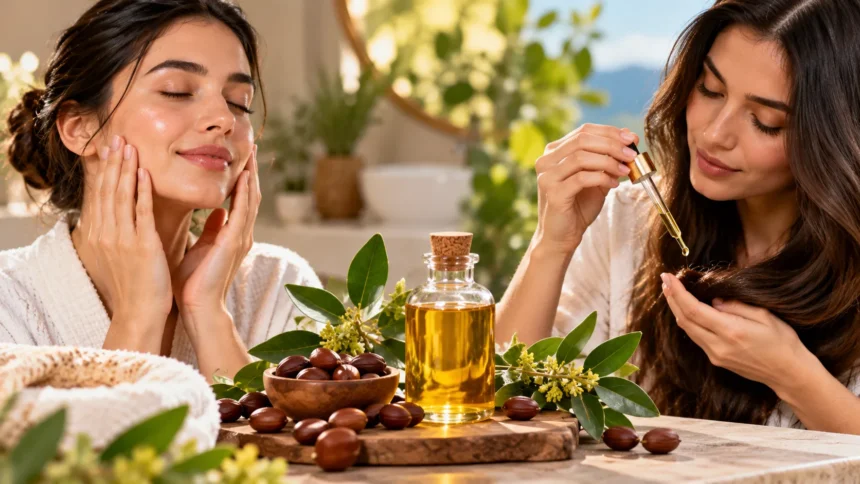
Jojoba oil is a popular natural ingredient used in skincare and haircare products because of its moisturizing properties and lightweight texture. Extracted from the seeds of the jojoba plant, it is commonly found in facial moisturizers, hair conditioners, lip balms, and body lotions. Its unique composition makes it useful for supporting skin comfort and improving the appearance of dry hair.
Unlike many traditional plant oils, jojoba oil consists mainly of liquid wax esters that resemble some components of human sebum. This characteristic helps explain why it spreads easily across the skin and hair. Although jojoba oil has several useful cosmetic properties, some popular claims about its ability to treat specific conditions require stronger scientific evidence.
Understanding jojoba oil benefits for skin and hair can help you decide whether it belongs in your personal care routine. From reducing moisture loss to making dry hair feel smoother, this botanical ingredient has several practical applications. This guide explains its properties, potential benefits, application methods, and precautions for different skin and hair types.
What Is Jojoba Oil?
Jojoba oil is a golden-colored liquid obtained from the seeds of the jojoba plant, scientifically known as Simmondsia chinensis. The plant grows naturally in arid regions of North America, particularly parts of the southwestern United States and northern Mexico. Its seeds contain a liquid wax commonly used in cosmetic and personal care formulations.
Although it is called an oil, jojoba is chemically different from most vegetable oils. It consists primarily of long-chain wax esters rather than triglycerides. This composition contributes to its stability, smooth texture, and usefulness in products designed to condition the skin and hair.
Jojoba oil is available as a standalone cosmetic ingredient or as part of moisturizers, shampoos, conditioners, and serums. Some products contain refined jojoba oil, while others use less processed versions. The final formulation determines how the ingredient feels and performs during everyday use.
Why Is Jojoba Oil Popular in Skincare and Haircare?
Jojoba oil has become popular because it provides a smooth, conditioning feel without the heaviness associated with some other oils. It spreads easily over the skin and hair, making it suitable for various cosmetic products. Its stable composition also contributes to its usefulness in commercially manufactured formulations.
Another advantage is its versatility across different personal care routines. Jojoba oil can function as an emollient in facial moisturizers, a conditioning ingredient in hair products, or a protective component in lip balms. These applications focus primarily on improving texture, comfort, and moisture retention.
However, natural origin does not automatically make jojoba oil suitable for everyone. Individual skin sensitivity, existing conditions, and product formulation can affect tolerance. Understanding its practical cosmetic benefits helps separate established moisturizing uses from exaggerated claims about treating medical or dermatological problems.
How Jojoba Oil Benefits the Skin
One of the main jojoba oil benefits for skin is its ability to act as an emollient. Emollients help soften the skin’s surface and improve its overall feel. Jojoba oil also forms a light protective layer that can help reduce moisture loss from the outer skin.
This moisturizing action may be particularly useful for skin that feels dry, rough, or uncomfortable. When incorporated into an appropriate skincare routine, jojoba oil can help maintain a smoother surface. However, its effectiveness depends on the amount used and whether additional moisturizing ingredients are present.
Jojoba oil is not a substitute for every skincare treatment. While it can support moisture retention, it does not independently address all causes of redness, irritation, or other skin concerns. Its most reliable role is as a conditioning ingredient within a balanced skincare routine.
Jojoba Oil Helps Moisturize Dry Skin
Dry skin develops when the outer skin layer struggles to retain sufficient moisture. Environmental conditions, harsh cleansing products, and certain skin disorders can contribute to this problem. Jojoba oil may help reduce moisture loss by creating a lightweight conditioning layer over the skin.
Applying a suitable moisturizer containing jojoba oil can make dry areas feel softer and more comfortable. Products that also contain humectants, such as glycerin, may provide additional hydration support. This combination helps address different aspects of moisture retention rather than relying on oil alone.
People with very dry skin may benefit from richer moisturizing creams designed to support the skin barrier. Jojoba oil can be an optional ingredient in these formulations. Persistent cracking, inflammation, or painful dryness should be evaluated by a healthcare professional rather than treated only with cosmetic oil.
Can Jojoba Oil Support the Skin Barrier?
The skin barrier is the outer protective layer that helps prevent excessive water loss and limits exposure to environmental irritants. When this barrier becomes compromised, skin may feel dry, tight, or sensitive. Moisturizing ingredients can help support comfort while the skin maintains its natural protective functions.
Jojoba oil contributes to skin conditioning by forming an emollient layer on the surface. This may help reduce moisture loss and improve the feeling of softness. However, jojoba oil has not been established as a complete replacement for barrier-supporting ingredients such as ceramides.
A gentle skincare routine can support the skin barrier more effectively than relying on a single ingredient. Mild cleansing, appropriate moisturizing, and protection from excessive sun exposure are important considerations. Jojoba oil may complement these habits when the product is well tolerated.
Is Jojoba Oil Good for Oily Skin?
Jojoba oil is sometimes recommended for oily skin because its wax esters share certain structural similarities with components of human sebum. Its lightweight texture may also appeal to people who dislike thick creams. However, these characteristics do not prove that jojoba oil regulates natural oil production.
Sebum production is influenced by genetics, hormones, and other biological factors. There is insufficient clinical evidence that applying jojoba oil causes sebaceous glands to produce less oil. Claims that it automatically balances oily skin should therefore be interpreted cautiously.
People with oily skin may still find certain jojoba-containing products comfortable to use. The entire formulation matters because added ingredients can affect greasiness, irritation, and pore-related concerns. Choosing a lightweight, non-comedogenic moisturizer is generally more important than selecting products based on one botanical ingredient.
Can Jojoba Oil Help With Acne-Prone Skin?
Acne develops through several interacting factors, including clogged hair follicles, inflammation, and changes in oil production. Jojoba oil is frequently promoted as suitable for acne-prone skin because of its conditioning properties. However, strong clinical evidence showing that it effectively treats acne remains limited.
Some laboratory research has explored biological activities associated with jojoba-derived compounds. These findings do not demonstrate that ordinary jojoba oil can clear pimples or prevent breakouts. Individuals may also respond differently depending on their skin characteristics and the products used alongside it.
For acne-prone skin, gentle cleansing and non-comedogenic moisturizers are useful foundations. Established acne treatments may be necessary when breakouts are persistent or troublesome. Jojoba oil can be considered an optional moisturizer ingredient, but it should not replace evidence-based acne care.
Potential Anti-Inflammatory Properties of Jojoba Oil
Certain laboratory and preclinical studies have investigated jojoba oil for potential anti-inflammatory effects. These findings suggest that some components may influence biological processes associated with inflammation. However, results from laboratory or animal research cannot automatically be applied to everyday human skincare.
People sometimes describe jojoba oil as soothing because it reduces the feeling of dryness and friction. This cosmetic effect may make the skin feel more comfortable. Nevertheless, a pleasant sensation does not establish that the ingredient treats inflammatory skin disorders.
Individuals experiencing ongoing redness, swelling, itching, or discomfort should identify the underlying cause. Botanical oils can occasionally trigger irritation instead of reducing it. Appropriate medical care remains important when symptoms persist or involve an existing skin condition.
Jojoba Oil and the Appearance of Fine Lines
Fine lines may become more noticeable when the skin is dry or lacks sufficient surface moisture. Emollients can temporarily improve the skin’s appearance by creating a smoother, more conditioned surface. Jojoba oil may contribute to this effect when included in moisturizing skincare products.
Some people associate jojoba oil with anti-aging skincare because of its stability and naturally occurring compounds. However, clinical evidence does not establish that it reverses wrinkles or restores lost collagen. Its benefits should be understood primarily in terms of moisture retention and skin conditioning.
Daily sun protection remains one of the most important ways to reduce premature visible skin aging. A suitable moisturizer can also improve comfort and the appearance of dryness-related lines. Jojoba oil may complement these products without replacing established skincare practices.
Does Jojoba Oil Help With Dark Spots?
Dark spots can result from sun exposure, inflammation, hormonal changes, and other skin-related processes. Effective treatment depends on understanding the underlying cause and selecting suitable skincare ingredients. Although jojoba oil moisturizes the skin, it is not an established treatment for hyperpigmentation.
Applying an emollient may improve overall skin comfort and reduce the appearance of dryness. However, this does not mean it removes excess pigment or changes melanin production. There is insufficient clinical evidence that ordinary jojoba oil reliably fades dark spots.
People concerned about uneven pigmentation should prioritize appropriate sun protection and consider professional skincare advice. Ingredients specifically studied for hyperpigmentation may provide more targeted benefits. Jojoba oil can remain part of a moisturizing routine without being treated as a skin-lightening solution.
Jojoba Oil Benefits for Sensitive Skin
Sensitive skin may react to environmental conditions, skincare ingredients, or changes in the skin barrier. Jojoba oil is included in many moisturizing products because of its smooth texture and conditioning properties. Some individuals may find it comfortable, particularly in simple formulations.
However, even botanical ingredients can cause irritation or allergic reactions. The presence of added fragrance, essential oils, or other substances may further affect product tolerance. A product labeled natural or gentle is not automatically suitable for every person with sensitive skin.
Testing a small area before wider application can help identify obvious sensitivity. If itching, redness, or burning develops, the product should be discontinued. People with persistent skin sensitivity may benefit from fragrance-free moisturizers and guidance from a qualified healthcare professional.
How Jojoba Oil Benefits Hair
Jojoba oil is commonly used in haircare products because it helps condition the hair surface. Its waxy composition can provide lubrication, making dry strands feel smoother and easier to manage. These effects may improve the appearance of hair without changing its underlying growth cycle.
Hair becomes rough when the outer cuticle experiences wear, environmental exposure, or mechanical friction. Conditioning ingredients help reduce friction and improve how strands feel during grooming. Jojoba oil can contribute to these benefits when applied in suitable amounts or included in a formulated conditioner.
The most reliable hair benefits involve surface conditioning rather than permanent structural repair. Jojoba oil does not reconstruct damaged hair fibers or reverse split ends. It can still be useful for making hair feel softer and reducing the appearance of dryness between washes.
Jojoba Oil Helps Soften Dry Hair
Dry hair often feels rough because its surface does not retain or distribute conditioning substances effectively. Heat styling, chemical treatments, and environmental exposure can contribute to dryness. Jojoba oil helps coat strands with a light conditioning layer that may improve softness.
A small amount in a haircare formulation can reduce the feeling of roughness and improve manageability. Some people prefer applying conditioning products mainly to the lengths and ends of their hair. This helps avoid unnecessary buildup near the scalp.
Jojoba oil does not replace the water and conditioning agents supplied by a well-formulated haircare routine. Shampoo, conditioner, and appropriate styling habits remain important. Combining suitable products can provide more consistent results than relying exclusively on a single oil.
Can Jojoba Oil Reduce Frizz?
Frizz occurs when hair strands become unevenly aligned, often because of humidity, dryness, or differences in hair texture. Damaged cuticles and mechanical friction may make this appearance more noticeable. Conditioning products help improve surface smoothness and reduce friction between strands.
Jojoba oil may temporarily make frizzy hair appear smoother by coating the hair surface. Its lightweight feel can be useful in certain leave-in products. However, the results depend on hair type, product concentration, and environmental conditions.
Using excessive oil may leave some hair types looking greasy or weighed down. Fine hair may require lighter formulations than thick or coarse hair. A balanced conditioning routine is generally more effective than repeatedly applying large amounts of oil.
Jojoba Oil for Scalp Moisturizing
The scalp is skin and can experience dryness, discomfort, and sensitivity. Jojoba oil may act as an emollient on the scalp surface, helping reduce the feeling of dryness. However, scalp symptoms can have several causes that require different approaches.
Dryness caused by environmental exposure or harsh cleansing may respond to gentler haircare practices. Conditions such as seborrheic dermatitis, psoriasis, or contact dermatitis require more specific care. Applying oil without understanding the cause may not improve symptoms and can sometimes make them worse.
People with persistent scalp itching, redness, or flaking should consider professional evaluation. Jojoba oil may be suitable as an occasional conditioning ingredient when tolerated. It should not be viewed as a universal treatment for scalp disorders.
Does Jojoba Oil Help With Dandruff?
Dandruff commonly involves scalp flaking associated with factors such as seborrheic dermatitis and the activity of naturally occurring skin microorganisms. It is not always caused by a simple lack of moisture. This distinction matters when evaluating oils marketed as dandruff remedies.
Jojoba oil can soften dry skin, but there is insufficient clinical evidence that it reliably treats dandruff. In some individuals, additional oily products may worsen scalp buildup or discomfort. A moisturizing sensation should not be confused with treating the underlying condition.
Evidence-based anti-dandruff shampoos contain ingredients selected to manage flaking and related scalp symptoms. Persistent or severe cases may require professional guidance. Jojoba oil should remain an optional conditioning ingredient rather than a replacement for appropriate dandruff treatment.
Can Jojoba Oil Promote Hair Growth?
Hair growth depends on complex biological processes involving hair follicles, genetics, hormones, and general health. Jojoba oil is sometimes promoted as a natural hair growth treatment. However, reliable human clinical evidence demonstrating that topical jojoba oil increases hair growth is lacking.
Improving hair manageability may help reduce certain forms of mechanical damage during grooming. This can make existing hair appear healthier and limit avoidable breakage. Nevertheless, reducing breakage is different from stimulating new hair growth at the follicle.
People experiencing unusual hair shedding or thinning should consider the potential underlying causes. Nutritional deficiencies, medical conditions, medications, and hormonal factors may contribute to hair loss. A healthcare professional can help identify appropriate evaluation and treatment options.
Jojoba Oil for Curly and Coarse Hair
Curly and coarse hair can benefit from conditioning products that improve lubrication and manageability. Natural curls create variations in how sebum travels along the hair shaft, which can contribute to dryness. Jojoba oil may help condition the surface and reduce friction during styling.
Hair products containing jojoba oil are often combined with other conditioning ingredients to support softness. The amount required depends on hair density, length, and individual texture. Some people may prefer richer formulas, while others achieve better results with lightweight leave-in conditioners.
Jojoba oil does not change natural curl patterns or permanently repair damaged strands. Its primary benefit is improving the feel and appearance of hair through surface conditioning. Choosing products suited to personal hair characteristics is more useful than assuming one oil works equally well for everyone.
How to Use Jojoba Oil on Your Face
Jojoba oil is commonly included in facial moisturizers and other leave-on skincare products. It may help soften the skin and reduce moisture loss when used in an appropriate formulation. People considering a standalone cosmetic oil should first check its intended use and ingredient quality.
New products are best introduced cautiously, especially when the skin is sensitive or acne-prone. A small-area test can help identify obvious irritation before wider application. Jojoba oil should not be applied to broken or infected skin without appropriate professional advice.
A basic facial skincare routine generally focuses on gentle cleansing, moisturizing, and daytime sun protection. Jojoba oil can be an optional addition when it provides comfortable conditioning. Its use should depend on individual tolerance rather than claims that it is essential for healthy skin.
How to Use Jojoba Oil on Hair
Jojoba oil can be found in rinse-out conditioners, leave-in treatments, and styling products. These formulations are designed to distribute conditioning ingredients across the hair surface. The manufacturer’s instructions provide the most reliable guidance for applying a specific product.
For people using a cosmetic jojoba oil intended for hair, a minimal amount may provide sufficient surface conditioning. Focusing on dry lengths and ends can help avoid excessive buildup. Individual preferences and hair texture influence whether an oil feels comfortable or too heavy.
Haircare products should also be used in ways that minimize unnecessary friction and damage. Gentle detangling and avoiding excessive heat can support hair appearance. Jojoba oil may complement these habits but does not substitute for a suitable conditioner or appropriate hair maintenance.
How Often Should You Use Jojoba Oil?
There is no universal application frequency that guarantees better skin or hair results from jojoba oil. Suitable use depends on product formulation, individual tolerance, and personal care needs. Some moisturizers contain jojoba oil for regular application, while concentrated oils may feel excessive when used frequently.
Skin that becomes greasy, irritated, or uncomfortable may not benefit from additional applications. Similarly, hair can appear weighed down if too much conditioning oil accumulates. Observing the response of the skin or hair is more useful than following an inflexible schedule.
Consistency with a simple personal care routine is usually more important than frequent oil application. Products should be used according to their directions and discontinued if unwanted reactions occur. Jojoba oil remains an optional ingredient rather than a required daily treatment.
Choosing the Best Jojoba Oil for Skin and Hair
Jojoba oil products vary in processing methods, purity, packaging, and intended cosmetic use. Some contain jojoba oil as the main ingredient, while others blend it with fragrances or additional plant oils. Reading product labels helps identify formulations that match personal preferences.
Cold-pressed jojoba oil is commonly marketed as a minimally processed option. Refined versions may have a lighter color or less noticeable scent, depending on the manufacturing process. Neither processing description automatically proves that a product will perform better for every skin or hair type.
Choosing products from reputable manufacturers helps improve confidence in labeling and quality. Packaging, expiration information, and storage instructions should also be considered. People with sensitive skin may prefer simpler formulations without added fragrance or unnecessary essential oils.
Possible Side Effects of Jojoba Oil
Jojoba oil is generally used as a cosmetic conditioning ingredient, but unwanted reactions are possible. Some individuals may experience redness, itching, or contact dermatitis after application. Sensitivity can also result from preservatives, fragrances, or other ingredients included in a finished product.
Applying excessive quantities may leave the skin greasy or contribute to unwanted product buildup. Some acne-prone individuals may find particular oil-based formulations unsuitable. Reactions depend on the whole product and individual sensitivity rather than the ingredient name alone.
Jojoba oil is intended for external cosmetic use and should not be swallowed. Discontinue application if irritation develops, and seek professional advice for persistent symptoms. Severe allergic reactions require urgent medical attention, although they are not typical outcomes of routine cosmetic use.
Common Myths About Jojoba Oil Benefits
A common myth is that jojoba oil can completely stop the skin from producing excess sebum. Although its wax esters resemble some natural skin lipids, this similarity does not prove that it regulates sebaceous glands. Oil production is influenced by several biological factors.
Another misconception is that jojoba oil can directly regrow lost hair or permanently repair split ends. Its conditioning effects may reduce friction and improve appearance, but they do not establish new follicle growth or restore damaged hair fibers. These claims should be evaluated against reliable scientific evidence.
Some people also assume that natural oils cannot cause allergic reactions. Botanical ingredients may still irritate sensitive skin or interact poorly with particular formulations. Recognizing these limitations helps consumers make realistic decisions about jojoba oil and other natural personal care ingredients.
Conclusion
Jojoba oil is a versatile cosmetic ingredient valued for its moisturizing, softening, and conditioning properties. Its unique wax ester composition makes it useful in products designed for dry skin, hair manageability, and surface moisture retention. These practical benefits explain its popularity across skincare and haircare formulations.
Although jojoba oil may improve skin comfort and hair texture, many popular claims require stronger scientific support. It has not been established as a reliable treatment for acne, dandruff, hair loss, or deep wrinkles. Understanding this distinction helps prevent unrealistic expectations and encourages more informed product choices.
The best results come from using suitable products within a balanced personal care routine. Gentle cleansing, effective moisturizing, appropriate hair conditioning, and sun protection remain important foundations. Jojoba oil can be a useful addition when tolerated, but it is not essential for maintaining healthy skin and hair.
Frequently Asked Questions (FAQs)
What Are the Main Benefits of Jojoba Oil for Skin?
Jojoba oil acts as an emollient that helps soften skin and reduce moisture loss. It may improve comfort and smoothness, although evidence for treating specific skin conditions remains limited.
Can Jojoba Oil Help Hair Grow Faster?
There is insufficient clinical evidence that jojoba oil stimulates hair growth. It may improve conditioning and reduce friction-related breakage, but these effects do not demonstrate increased activity in hair follicles.
Is Jojoba Oil Good for Oily and Acne-Prone Skin?
Some lightweight jojoba-containing products may suit oily skin, but individual reactions vary. Jojoba oil has not been proven to control sebum production or reliably treat acne.
Can I Use Jojoba Oil on My Face Every Day?
Regular use may be suitable when the product is well tolerated, but daily application is not essential. Follow product instructions and discontinue use if irritation or unwanted breakouts develop.
Is Jojoba Oil Better for Skin or Hair?
Jojoba oil provides useful cosmetic conditioning for both skin and hair. It helps soften skin and improve hair manageability, so the better application depends on individual needs and product formulation.