

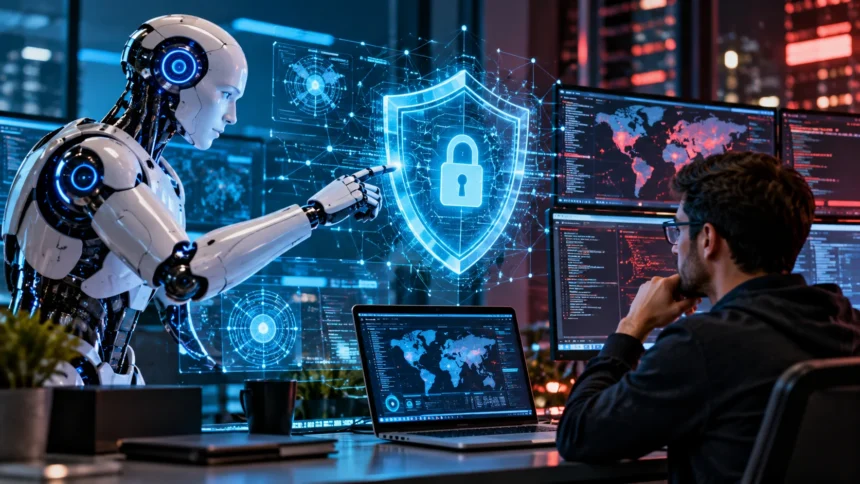
Artificial intelligence is changing how businesses protect their systems, networks, and sensitive information. From detecting suspicious activities to identifying security vulnerabilities, AI-powered tools are becoming increasingly important in modern cybersecurity. As these technologies become more advanced, many students and IT professionals are asking an important question: Will AI replace cyber security?
The short answer is that AI is unlikely to replace cybersecurity entirely, but it will change how cybersecurity professionals work. Artificial intelligence can automate repetitive tasks, analyze large amounts of data, and identify potential threats quickly. However, human expertise remains essential for complex decision-making, security planning, and managing unexpected cyber threats.
In this guide, we will explore how AI is transforming cybersecurity, which jobs and tasks may be affected, and why human professionals are still important. You will also learn about future cybersecurity careers, essential skills, and how to prepare for an industry increasingly influenced by artificial intelligence.
Will AI Replace Cyber Security in the Future?
AI is not expected to completely replace cybersecurity because protecting digital systems involves more than identifying technical threats. Cybersecurity professionals must understand business requirements, evaluate risks, and make important security decisions. Although AI can assist with these activities, it cannot independently guarantee the accuracy or effectiveness of every recommendation.
Artificial intelligence is particularly useful for processing large amounts of information and recognizing suspicious patterns. Security teams can use AI-powered systems to prioritize alerts, investigate unusual activities, and reduce repetitive workloads. These capabilities improve efficiency but still require human supervision to prevent errors and inappropriate responses.
The future of cybersecurity will likely involve greater collaboration between humans and intelligent technologies. Professionals who understand both cybersecurity principles and AI capabilities may become increasingly valuable. Rather than eliminating the profession, artificial intelligence is expected to reshape job responsibilities and create demand for different technical skills.
How Artificial Intelligence Is Changing Cybersecurity
Artificial intelligence is transforming cybersecurity by helping organizations identify, analyze, and respond to potential security threats more efficiently. Traditional security systems often depend on predefined rules and known attack patterns. AI-powered tools can also analyze behavioral patterns and identify unusual activities that may require investigation.
Machine learning algorithms can process information from networks, applications, devices, and security logs. By recognizing patterns across large datasets, these systems can highlight potential risks that would be difficult to identify manually. This allows cybersecurity teams to focus attention on incidents that appear more significant.
AI is also changing how security professionals manage everyday responsibilities. Automated reporting, alert classification, and vulnerability prioritization can reduce time spent on repetitive administrative work. However, organizations must evaluate the accuracy of these systems because unreliable AI recommendations can introduce additional security challenges.
Can AI Replace Cybersecurity Professionals?
AI can perform some responsibilities traditionally handled by cybersecurity professionals, but it cannot reliably replace every aspect of their work. Security specialists need technical knowledge, analytical thinking, and an understanding of organizational priorities. These abilities become especially important when dealing with unfamiliar threats or complicated security incidents.
For example, an AI tool might identify suspicious activity within a company network and recommend a response. However, a cybersecurity analyst may need to determine whether the activity represents a real threat or legitimate business operations. Acting on an incorrect recommendation could interrupt essential services or create additional problems.
Human professionals are also responsible for communicating security risks, developing policies, and supporting organizational decisions. These responsibilities involve judgment, accountability, and cooperation with different departments. AI may assist with gathering information, but businesses still need skilled people to evaluate consequences and approve important actions.
Which Cybersecurity Tasks Can AI Automate?
Many routine cybersecurity tasks are suitable for AI-assisted automation because they involve repetitive analysis and large volumes of data. Examples include security alert classification, log analysis, suspicious activity detection, and basic report generation. Automation can reduce manual effort and help security teams manage growing workloads.
AI-powered tools can also assist with vulnerability management by organizing security findings and identifying systems that may require attention. Some systems summarize incident information or suggest possible investigation priorities. However, their recommendations must be reviewed because automated analysis can overlook important context or produce inaccurate conclusions.
The greatest benefits often come from combining automation with clear human oversight. Security professionals can use AI to complete preliminary analysis while concentrating on difficult investigations and strategic improvements. This approach allows organizations to benefit from technology without relying entirely on automated decision-making.
Cybersecurity Tasks That Still Need Human Expertise
Complex security investigations require human judgment because cyber incidents do not always follow predictable patterns. Professionals must understand the organization’s technology, identify potential business consequences, and evaluate conflicting evidence. AI can support these investigations but may struggle when information is incomplete or misleading.
Security strategy is another area that requires experienced professionals. Organizations need people who can develop policies, evaluate acceptable risks, and coordinate protection across different departments. These decisions depend on business objectives, legal obligations, available resources, and other considerations that extend beyond technical analysis.
Communication and leadership also remain important parts of cybersecurity work. Security professionals must explain threats to employees, executives, and customers in understandable language. During major incidents, human coordination helps ensure that technical responses align with organizational responsibilities and operational requirements.
Will AI Replace Cybersecurity Analysts?
Cybersecurity analysts are among the professionals most likely to experience changes in their everyday responsibilities. Many analysts review security alerts, examine logs, and investigate unusual behavior. AI-powered tools can automate portions of these activities, potentially reducing the amount of manual screening required.
However, security analysts also investigate complex incidents and determine whether suspicious events represent genuine threats. Automated tools sometimes generate false positives or overlook important details. Human analysts remain valuable because they can connect technical findings with organizational context and decide which situations require further attention.
Entry-level analyst positions may evolve as employers adopt more automation. New professionals may need stronger skills in interpreting AI-generated findings, investigating complex incidents, and understanding security systems. Learning these abilities can help aspiring analysts remain competitive as traditional workflows continue changing.
Will AI Replace Ethical Hackers and Penetration Testers?
Ethical hacking and penetration testing involve evaluating the security of systems with appropriate authorization. AI can assist security professionals by analyzing configurations, organizing findings, and identifying common weaknesses. These capabilities may improve productivity and reduce the time required for certain assessment activities.
However, professional security testing involves more than recognizing technical vulnerabilities. Testers must understand business requirements, evaluate the significance of findings, and communicate recommendations responsibly. Human judgment is important when determining how security weaknesses could affect actual operations.
AI may increasingly support penetration testing workflows, but complete replacement remains uncertain. Organizations still need qualified professionals who understand testing boundaries, legal permissions, and responsible security practices. Combining cybersecurity expertise with knowledge of AI-assisted assessment tools may become a valuable professional skill.
Will AI Replace Security Operations Center Jobs?
Security Operations Centers, commonly called SOCs, monitor and investigate possible threats affecting organizational systems. Traditional SOC teams often handle large numbers of alerts generated by different security tools. AI can assist by grouping related events, summarizing findings, and identifying alerts that deserve closer examination.
These capabilities may reduce the amount of routine work assigned to some entry-level security analysts. However, automated systems can make mistakes when identifying threats or interpreting unusual network behavior. Security teams still need professionals who can investigate uncertain situations and make informed response decisions.
The structure of SOC jobs may change as automation becomes more common. Professionals may spend less time reviewing repetitive alerts and more time investigating complicated incidents or improving detection systems. Developing technical judgment and familiarity with automated security platforms can help workers adapt to these changes.
Advantages of Using AI in Cybersecurity
One of the biggest advantages of AI in cybersecurity is its ability to analyze large amounts of information quickly. Modern organizations generate enormous volumes of security data from applications, devices, and networks. AI-powered systems can help identify unusual patterns and highlight events requiring further investigation.
Another advantage is improved operational efficiency. Automated classification, reporting, and preliminary investigation can reduce repetitive work for security teams. This may allow professionals to spend more time addressing complex threats, improving security controls, and supporting organizational risk management.
AI can also support continuous monitoring because automated systems can process information throughout the day. However, continuous analysis does not guarantee that every threat will be detected. Effective cybersecurity still requires suitable technology, experienced professionals, updated procedures, and regular evaluation of security performance.
Limitations of Artificial Intelligence in Cybersecurity
Artificial intelligence has important limitations that prevent it from serving as a complete replacement for cybersecurity professionals. AI systems depend on training data, system design, and the information available during analysis. Inaccurate or incomplete information can lead to unreliable security recommendations.
False positives and false negatives remain significant challenges. An AI system may incorrectly classify normal activity as suspicious or fail to identify an actual threat. These errors can create unnecessary work or allow important security incidents to go unnoticed.
Another limitation involves the difficulty of explaining some AI-generated decisions. Organizations may need to understand why a system recommended a particular action before approving it. Transparency, accountability, and human oversight are especially important when automated security decisions could affect essential business operations.
Can Hackers Use AI Against Cybersecurity Systems?
Artificial intelligence can be used for both defensive and malicious purposes, creating new challenges for cybersecurity professionals. Attackers may use AI to produce more convincing fraudulent messages, automate certain activities, or analyze publicly available information. These developments increase the importance of effective security awareness and protective controls.
AI-generated phishing messages are one example of how emerging technology can complicate traditional security practices. Such messages may contain fewer obvious spelling or grammar mistakes than older fraudulent communications. Organizations therefore need security awareness programs that emphasize careful verification rather than relying entirely on familiar warning signs.
Cybersecurity professionals must also protect AI systems against manipulation, unauthorized access, and unreliable outputs. As businesses adopt intelligent tools, the systems themselves become important security considerations. This creates additional responsibilities for professionals who understand both information security and artificial intelligence.
Is Cybersecurity Still a Good Career in the Age of AI?
Cybersecurity remains a promising career field because organizations continue to depend on secure digital systems and reliable information protection. Businesses, educational institutions, healthcare providers, and government organizations face evolving cyber risks. These challenges create ongoing demand for professionals who can understand and manage security requirements.
However, AI adoption is changing the skills employers may expect from cybersecurity workers. Repetitive tasks are becoming easier to automate, while complex investigation, cloud security, risk management, and AI governance are gaining importance. Career opportunities will vary depending on economic conditions, location, experience, and employer requirements.
Students considering cybersecurity should focus on developing adaptable technical and analytical skills. Learning networking, operating systems, programming fundamentals, and security principles provides a strong foundation. Adding practical knowledge of AI-powered security tools can help prepare for changing professional responsibilities.
Cybersecurity Jobs That AI May Transform
Different cybersecurity roles will experience AI adoption in different ways. Security analysts, vulnerability management specialists, incident responders, and compliance professionals already perform tasks that can benefit from automated analysis. The level of transformation depends on how organizations introduce AI into their existing workflows.
The following table summarizes several cybersecurity roles and how AI may affect their responsibilities.
| Cybersecurity Role | Potential Impact of AI |
|---|---|
| SOC Analyst | Automates routine alert analysis |
| Security Analyst | Supports threat investigation |
| Penetration Tester | Assists authorized assessments |
| Incident Responder | Summarizes events and evidence |
| Security Engineer | Supports monitoring and configuration reviews |
| Cloud Security Specialist | Assists with cloud risk analysis |
| Security Auditor | Helps organize compliance information |
| Security Manager | Supports reporting and risk assessment |
These changes do not mean the listed professions will disappear. Instead, workers may spend less time completing repetitive tasks and more time evaluating complex findings. Employers will continue determining which responsibilities require human approval and professional accountability.
The long-term impact of AI on cybersecurity employment remains uncertain because technology, regulations, and business requirements continue evolving. Some jobs may become more automated while new specialties emerge. Professionals who continue learning are likely to have more options as the industry changes.
New Cybersecurity Careers Created by AI
As organizations adopt artificial intelligence, they also need professionals who understand how to protect AI-powered systems. This has increased interest in specialties involving AI security, model risk assessment, and responsible technology governance. These roles combine established cybersecurity principles with knowledge of modern machine learning systems.
AI security specialists may evaluate how intelligent applications handle sensitive data, permissions, and security risks. Other professionals focus on identifying weaknesses in AI systems or ensuring that automated decisions comply with organizational policies. These responsibilities require technical expertise alongside an understanding of responsible technology use.
Additional opportunities may emerge in AI governance, cloud security, and security automation engineering. Job titles and responsibilities will continue changing as organizations develop new technologies. Building a strong cybersecurity foundation can make it easier to explore these specialized career paths.
Skills Cybersecurity Professionals Need for the AI Future
Technical knowledge remains essential for anyone planning a cybersecurity career. Professionals should understand computer networks, operating systems, identity management, and common security principles. These foundational skills help them interpret AI-generated findings and recognize when automated recommendations may be inaccurate.
AI literacy is becoming another valuable skill. Cybersecurity workers benefit from understanding how machine learning systems operate, where their limitations exist, and how automated tools should be evaluated. Familiarity with data analysis and programming concepts can also support more advanced technical responsibilities.
Communication, problem-solving, and critical thinking are equally important. Security professionals must explain complex risks, collaborate with colleagues, and make decisions when information is uncertain. Combining these human abilities with technical knowledge can help individuals adapt to increasingly automated cybersecurity environments.
How to Start Learning Cybersecurity With AI
Beginners interested in cybersecurity should start by understanding how computers and networks operate. Topics such as internet protocols, operating systems, access controls, and information security principles provide an important foundation. Learning these concepts first makes it easier to understand more advanced cybersecurity technologies.
The next step is developing practical knowledge through structured courses and authorized learning environments. Beginners can explore security concepts using educational simulations and training laboratories specifically designed for safe practice. Introductory programming and data analysis skills can also help explain how automated security systems process information.
After learning the fundamentals, students can begin studying artificial intelligence concepts relevant to cybersecurity. These may include machine learning, anomaly detection, model reliability, and responsible automation. Building knowledge gradually helps learners develop useful skills without depending entirely on AI-generated answers.
Will AI Replace Cybersecurity by 2030?
Predicting the exact impact of artificial intelligence on cybersecurity by 2030 is difficult because technology develops rapidly. AI systems are likely to become more capable of analyzing security information and automating routine workflows. However, greater automation does not necessarily mean that organizations will eliminate human cybersecurity teams.
Security decisions often involve business risks, legal responsibilities, and consequences that require accountable human oversight. Organizations also need people who can evaluate AI performance, investigate unexpected incidents, and improve protective systems. These requirements are likely to remain important even as intelligent tools become more sophisticated.
By 2030, cybersecurity professionals may work with more advanced automation than they use today. Entry-level responsibilities could change, and specialized AI security knowledge may become increasingly valuable. Rather than assuming complete replacement, students should prepare for a profession where cybersecurity and artificial intelligence operate together.
How Businesses Can Balance AI and Human Cybersecurity
Businesses can benefit from AI-powered cybersecurity systems when automation is introduced with clear responsibilities and appropriate oversight. Automated tools may assist with monitoring, analysis, and reporting, while trained professionals review significant findings. This arrangement helps organizations improve efficiency without depending entirely on machine-generated decisions.
Successful implementation also requires regular evaluation of AI system performance. Security teams should understand the tools’ limitations and establish procedures for reviewing incorrect recommendations. Clear policies can help determine which activities are appropriate for automation and which require human authorization.
Employee training is equally important because technology cannot replace responsible security behavior across an organization. Staff members need guidance about data protection, suspicious communications, and approved technology use. Combining skilled professionals, suitable tools, and effective security policies creates a more balanced approach to organizational protection.
Conclusion
So, will AI replace cyber security? The most likely outcome is that artificial intelligence will transform cybersecurity rather than eliminate the profession completely. AI can automate repetitive tasks, analyze large datasets, and support security investigations. However, human professionals remain essential for complex decision-making, strategic planning, and evaluating uncertain situations.
Cybersecurity jobs will continue evolving as organizations introduce intelligent monitoring and automation tools. Some routine responsibilities may decline, while opportunities involving AI security, cloud protection, risk management, and governance may expand. Professionals who develop both traditional cybersecurity skills and AI knowledge can better prepare for these changes.
For students and aspiring professionals, cybersecurity remains a field worth exploring. Focus on networking, operating systems, security fundamentals, critical thinking, and responsible AI use. Continuous learning and adaptability will be important for building a successful career in an increasingly AI-driven digital world.
Frequently Asked Questions
Will AI completely replace cybersecurity jobs?
AI is unlikely to replace all cybersecurity jobs because organizations still require human judgment, security planning, and accountability. However, it may automate routine tasks and change the responsibilities of certain positions.
Is cybersecurity a good career after AI?
Yes, cybersecurity remains a relevant career because businesses need professionals to protect digital systems and manage emerging risks. Learning AI-related security skills can help improve future career opportunities.
Which cybersecurity jobs are most affected by AI?
Entry-level security monitoring, alert classification, log analysis, and routine reporting are among the tasks most affected by AI automation. Complex investigations, strategic planning, and governance still require human expertise.
Should I learn AI or cybersecurity first?
If your goal is a cybersecurity career, start with networking, operating systems, and security fundamentals. After building this foundation, learning AI concepts can help you understand modern security automation.
Will cybersecurity still exist in 2030?
Yes, cybersecurity is expected to remain essential in 2030, although its tools and job responsibilities will evolve. Organizations will continue needing professionals who understand security risks, AI systems, and human oversight.