

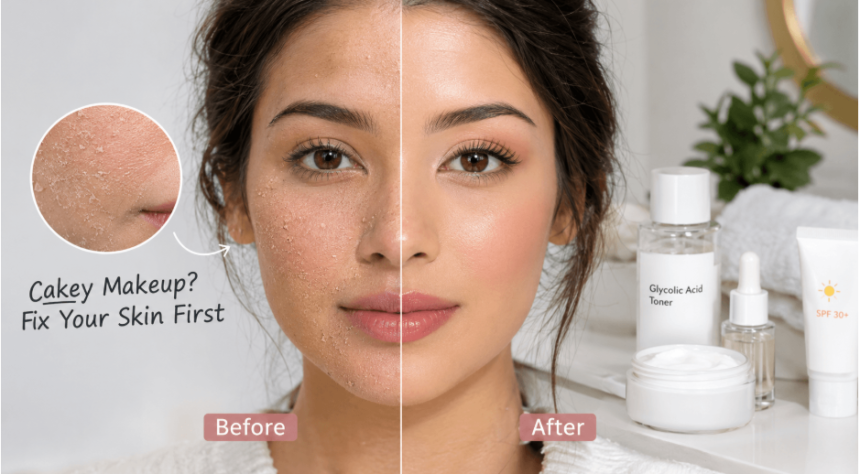
You’ve bought a good foundation, watched the tutorials, and used a damp sponge. Yet an hour into the event, your makeup is settling into lines, flaking around your nose, and sitting in patches on your cheeks.
Most girls blame the foundation and buy another one. But cakey makeup is usually a skin problem, not a makeup problem. When the skin underneath is rough, flaky or dehydrated, no product will sit smoothly on top.
The fix starts with skin prep. A gentle exfoliant like a glycolic acid toner, used a few nights a week, can make a bigger difference to your base than any new foundation.
Quick answer: Makeup looks cakey when it clings to dry patches, dead skin and texture. Exfoliate gently 2 to 3 nights a week with a glycolic acid toner, hydrate well, and use less product. Your base will look smoother within 2 to 3 weeks.
Why Does My Makeup Look Cakey?
Dead skin and dry patches
Foundation grabs onto flaky skin around the nose, chin and eyebrows. Instead of blending, it sticks to every dry flake and makes it more visible.
Dehydrated skin
Skin that’s low on water soaks up the moisture from your foundation. The makeup dries out, cracks and settles into fine lines.
Rough texture and bumps
Small bumps and uneven texture catch powder and foundation, so the surface looks patchy instead of smooth.
Too much product
Layering primer, foundation, concealer, setting powder and spray adds up quickly. The thicker the layers, the cakier it looks.
Oily T-zone, dry cheeks
Combination skin is common in Pakistan. Makeup slides off the oily areas and clings to the dry ones, which leaves an uneven finish.
The Fix: Prep Your Skin for Smooth Makeup
Great makeup starts the night before. The goal is smooth, hydrated skin that lets foundation melt in.
How glycolic acid helps
Glycolic acid is an alpha hydroxy acid (AHA). It gently loosens the dead skin cells that cause flakes and rough patches, so the surface becomes smoother and more even. The U.S. Food and Drug Administration lists it among the most common AHAs in skin care.
With a smoother surface, foundation spreads evenly and needs fewer layers.
Your night routine
- Remove all makeup with micellar water or a cleansing balm.
- Wash with a gentle cleanser.
- Pat dry and wait a minute.
- Apply the toner with a cotton pad, focusing on flaky areas like the nose and chin.
- Moisturise generously.
Your morning prep before makeup
- Rinse with water or a mild cleanser.
- Apply a hydrating serum, such as hyaluronic acid, on damp skin.
- Use a light moisturiser and give it 5 minutes to sink in.
- Apply sunscreen, SPF 30 or higher. AHAs make skin more sensitive to the sun.
- Then start your makeup.
How often to exfoliate
| Week | How often |
|---|---|
| 1–2 | 2 nights a week |
| 3–4 | 3 nights a week |
| Before an event | 2 nights before, not the same night |
Keep your routine simple
You don’t need a long list of skin care products to get a smooth base. A gentle cleanser, an exfoliating toner, a moisturiser and sunscreen cover most of it.
Makeup Tips for a Smoother Finish
- Use less foundation. Start with a small amount in the centre of your face and blend outwards.
- Apply with a damp sponge. It presses product in instead of dragging it.
- Powder only where you need it. Usually the T-zone, not the whole face.
- Skip heavy powder on dry areas. It settles into flakes and lines.
- Mist lightly between layers if your skin feels tight.
Mistakes That Make Makeup Cakey
- Scrubbing your face right before makeup. It leaves skin red and sensitive.
- Using the toner on the morning of an event. Use it 2 nights before instead.
- Skipping moisturiser on oily skin. Dehydrated oily skin still flakes.
- Sleeping in makeup. It builds up on the skin and makes texture worse.
- Piling on more powder to fix creases. It only makes the cakiness worse.
Frequently Asked Questions
Can I use a glycolic acid toner the night before a wedding?
It’s better to use it 2 nights before. That gives your skin a day to settle so it looks smooth, not red or sensitive.
Will exfoliating make my makeup last longer?
Yes, usually. Smoother, hydrated skin holds makeup more evenly, so it creases and flakes less through the day.
Is it okay for oily skin?
Yes. Glycolic acid suits oily and combination skin well. Pair it with a light, oil-free moisturiser.
Can I use it under my eyes?
No. Keep it away from the eye area, which is thinner and more sensitive.
The Bottom Line
Cakey makeup is rarely the foundation’s fault. It’s what the foundation is sitting on.
Exfoliate gently a few nights a week, keep your skin hydrated, wear sunscreen, and use less product. Give it two or three weeks, and your makeup should look smoother, last longer and feel lighter on your skin.