

Snoring is one of the most common sleep complaints in American homes. Sometimes it’s just noise. Other times it’s a sign that airflow is being restricted during the night. Either way, it tends to cost two people their rest the snorer, and whoever shares the room.
Oral appliances, usually called snoring mouth guards or mouthpieces, are among the most popular remedies, and the choices can be confusing. If you’d like to compare designs before spending money, a resource like SnoringMouthGuard, Best snoring mouth Guard lays out the differences between devices for US buyers. What follows covers the basics: why snoring happens, what the main device types do, how to fit one, and when a mouthpiece isn’t the right answer.
Why People Snore
Snoring is the sound of soft tissue vibrating in the upper airway. As you fall asleep, the muscles in your throat, tongue, and soft palate relax. In some people the airway narrows enough that air becomes turbulent as it passes through, and the tissue flutters. That flutter is the sound.
A number of things make narrowing more likely. Sleeping on your back lets gravity pull the tongue and soft palate toward the throat. Extra weight around the neck can press on the airway, and alcohol or sedatives close to bedtime relax the throat muscles even further. Nasal congestion from allergies, a cold, or a deviated septum forces you to pull air harder, which adds to the turbulence. Anatomy matters too: a smaller or recessed lower jaw, a long soft palate, or large tonsils all leave less room. And muscle tone in the throat tends to fade with age.
It’s worth figuring out which of these applies to you, because devices address different causes. A mouthpiece built to move the jaw forward won’t do much for snoring that comes mostly from a stuffy nose.
What a Mouthpiece Actually Does
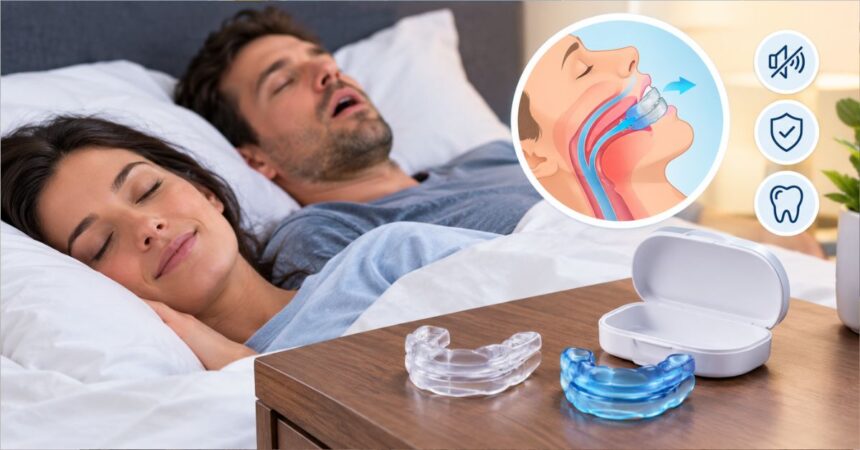
Most anti-snoring mouthpieces aim to keep the airway more open while you sleep. They do it one of two ways: by shifting the lower jaw forward or by holding the tongue forward. Either way, the goal is a little more space at the back of the throat so air can move through with less vibration.
Results vary a lot. Some people notice a real difference within a few nights. Others find a device uncomfortable or only partly helpful. That’s the main reason it pays to understand the types and the fitting process before you buy.
The Main Types
Mandibular advancement devices
The mandibular advancement device, or MAD, is the most common style. It resembles a sports mouth guard and fits over the upper and lower teeth. Hinges, connectors, or a fixed design hold the lower jaw slightly ahead of its natural resting position. Moving the jaw forward also firms up tissue at the back of the throat and widens the airway.
MADs come in three broad forms. Fixed-position models hold the jaw at one setting and are usually the simplest and cheapest. Adjustable models let you advance the jaw in small steps, so you can find the smallest adjustment that quiets your snoring. Custom-made models are built from impressions or scans of your teeth, typically through a dentist.
Tongue retaining devices
A tongue retaining device, or TRD, works differently. A small suction bulb holds the tongue gently forward so it can’t slide back into the throat. Because a TRD doesn’t grip the teeth, it can be an option for people whose dental situation makes a standard mouthpiece difficult. The suction feels odd at first, and some people never get comfortable with it, but others find it works well.
Boil-and-bite versus custom-fit
Within the MAD category, there are two main ways to get the fit. Boil-and-bite devices are softened in hot water, then molded by biting down. They’re affordable, easy to find, and a common starting point. Custom-fit devices are made from dental impressions or scans. They cost more, but they can fit more precisely and stay put better through the night.
How to Choose
With so many products out there, a short list of questions helps.
Start with your teeth and gums. Crowns, bridges, implants, and loose teeth can all affect which devices make sense, and jaw pain or gum disease is worth raising with a dentist before you wear anything that pulls the jaw forward.
Next, think about adjustability. If you don’t know how much advancement you need, an adjustable model gives you room to experiment. Too little may do nothing, while too much can leave your jaw sore.
Comfort matters more than most buyers expect. A bulky device is one you’ll end up pulling out at 2 a.m., so look at its profile, its material, and whether you can still breathe through your mouth if you need to. If you have sensitivities, check how the manufacturer describes the material (latex-free and BPA-free are common claims) and what cleaning method it recommends.
Finally, look at the return policy or trial period, since fit is personal and you may need a few tries. And be cautious about any product that promises to end snoring for everyone, immediately, with no adjustment. Honest sellers say what their devices can and can’t do.
Fitting a Boil-and-Bite Mouthpiece
Always follow the instructions that come with your specific device, because water temperature and timing differ from product to product. Overheating can warp the material, so read the directions before you start.
In general, you’ll soften the device as directed, usually in hot water for a short time, and let it cool briefly so it’s safe to put in your mouth. Then place it over your teeth, bite down gently, and press the material around your teeth with your fingers and tongue. If the device is adjustable, begin with minimal advancement and increase it gradually over several nights. Finish by cooling it as instructed so the shape sets.
A good fit feels snug without hurting. If it’s loose or shifts overnight, you may need to refit it, if the manufacturer allows that. Rushing this step is a common mistake. A poorly fitted device can irritate your gums or slip out while you sleep, so give yourself time, and don’t be discouraged if the first attempt isn’t perfect.
The First Few Weeks
Expect an adjustment period. Many people notice extra saliva or a dry mouth at first, along with some jaw tightness or mild soreness in the morning. Teeth can feel slightly sensitive, and your bite may feel “off” for a short while after you take the device out.
For most people these effects settle within a couple of weeks, and gentle jaw stretches in the morning can help your bite feel normal again. Persistent pain, tooth movement, clicking or locking of the jaw, or bite changes that don’t go away should not be ignored. If any of those happen, stop using the device and talk to your dentist or doctor.
Cleaning and Care
A mouthpiece spends hours in your mouth every night, so keep it clean. Rinse it in cool water after each use, since hot water can distort some materials. Brush it gently with a soft toothbrush and mild soap, or a cleaner the manufacturer recommends. Let it dry completely before putting it in its case, and keep it away from hot cars and direct sunlight.
Replace it if it cracks, warps, stains in a way you can’t clean, or stops fitting properly. Depending on the material and how often you use it, a device may last anywhere from several months to a couple of years. Follow the maker’s guidance on that.
Habits That Help
A mouthpiece works best alongside better sleep habits. Side sleeping often reduces airway collapse, and some people use a body pillow to stay in position. Cutting back on alcohol in the evening helps, since it relaxes the throat muscles. A steady sleep schedule matters too: when you’re overtired you tend to sleep more deeply and relax more, which can make snoring louder.
If nasal congestion is part of the picture, saline rinses, allergy management, or other approaches your clinician recommends may make nose breathing easier. For some people, even modest weight loss changes how much room the airway has. Raising your head slightly with a wedge pillow or an adjustable bed can also help.
When Snoring Signals Something More Serious
Not all snoring is the same. Loud, habitual snoring can be a sign of obstructive sleep apnea (OSA), a condition in which breathing repeatedly stops or becomes shallow during sleep. A mouthpiece is not a diagnosis, and it shouldn’t be treated as one.
Talk to a doctor if you or your partner notice pauses in breathing, or gasping or choking during sleep. The same goes for heavy daytime sleepiness even after a full night in bed, morning headaches, trouble concentrating, memory problems, or high blood pressure. Waking regularly with a dry mouth or sore throat is another reason to ask.
A sleep evaluation, done at home or in a sleep lab, can show whether you have sleep apnea. If you do, there are medically supervised treatments, and in some cases a dentist trained in sleep medicine can provide an oral appliance as part of your care. Using an over-the-counter device alone for a medical sleep disorder could leave the underlying problem untreated.
A Few Questions Before You Buy
It helps to be honest with yourself before committing. Do you snore every night, or mostly when you have a cold or have had a drink? Does your partner ever mention pauses in your breathing? Do you have jaw pain, dental work, or gum problems? Are you willing to go through some trial and adjustment? Have you read the return policy?
If your answers point to simple, occasional snoring and your dental health is good, a well-chosen mouthpiece is a reasonable thing to try. If any answer raises a health concern, see a healthcare provider first.
Final Thoughts
Snoring is common, but you don’t have to put up with it. For many people, a mouthpiece that suits the cause of their snoring, fits properly, and is paired with healthy sleep habits can make nights noticeably quieter. The key is to buy with your eyes open: know how mandibular advancement devices and tongue retaining devices differ, pick a fitting method you’re comfortable with, give yourself time to adjust, and pay attention to what your body tells you.
Better sleep rarely comes from a single fix. It comes from understanding what’s happening in your own airway, choosing sensible tools, and knowing when to bring in a professional. With a bit of patience and good information, a quieter night, for you and everyone in your home, is well within reach.